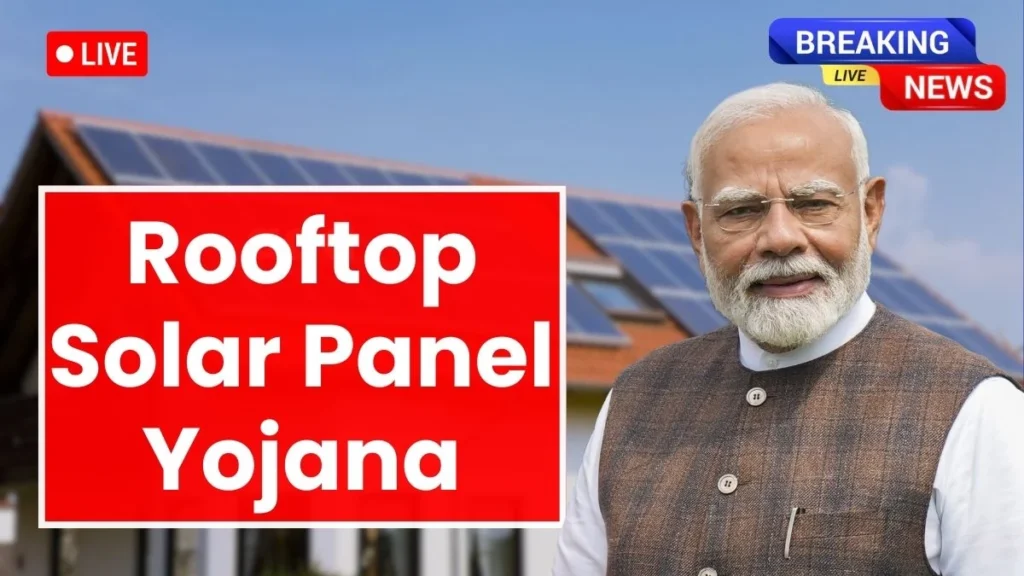
With electricity tariffs increasing steadily across many states, household power bills have become a growing concern for middle-class and lower-income families. To address this issue while promoting clean energy, the government has expanded support for the Rooftop Solar Yojana, making solar power more accessible to residential consumers. Under this scheme, eligible homeowners can begin the application process with a nominal registration amount, often around ₹500, and receive substantial financial assistance through subsidies.
What Is the Rooftop Solar Scheme and Why It Is Important
India’s electricity demand continues to grow due to urbanization, population growth, and increased use of electrical appliances. Traditional power generation methods, especially coal-based plants, contribute significantly to pollution and carbon emissions. The Rooftop Solar Scheme is designed to address these challenges by promoting decentralized solar energy generation at the household level.
Under this program, homeowners can install solar panels on their rooftops to generate electricity for personal use. The government provides subsidies to reduce upfront installation costs, making solar systems more affordable for ordinary citizens. This approach not only lowers electricity bills but also reduces pressure on the national power grid.
How Rooftop Solar Panels Reduce Monthly Electricity Bills
Once installed, rooftop solar panels convert sunlight into usable electricity during daytime hours. This power can be used to run common household appliances such as lights, fans, televisions, refrigerators, washing machines, and in some cases, air conditioners. Because the home uses self-generated electricity, the amount drawn from the electricity distribution company decreases significantly.
As a result, monthly power bills are reduced. In homes with sufficient solar capacity and efficient energy usage, bills can become minimal. The savings depend on factors such as system size, daily electricity consumption, and local sunlight conditions.
Solar System Cost and Government Subsidy Benefits
For an average household, a 2-kilowatt rooftop solar system is often adequate to meet regular electricity needs. The market price of such a system may be around ₹1.2 lakh, depending on equipment quality and installation charges. However, government subsidies can cover up to 40% of the benchmark cost for eligible residential consumers.
After applying the subsidy, the effective cost may reduce to approximately ₹70,000 to ₹75,000. Actual figures can vary by state, electricity distribution company, and system specifications. This financial support significantly lowers the entry barrier for households considering solar adoption.
Long-Term Financial Savings from Rooftop Solar Installation
One of the strongest reasons homeowners choose solar energy is long-term cost savings. A family spending ₹2,000 to ₹3,000 per month on electricity may pay nearly ₹30,000 annually. Over several years, this amount adds up substantially.
A rooftop solar system can typically recover its installation cost within 2 to 4 years through reduced electricity bills. After this payback period, the electricity generated is essentially free for the remaining lifespan of the system, which often ranges from 20 to 25 years. Over time, households may save several lakhs of rupees.
Net Metering Allows Additional Savings and Bill Adjustments
Many states offer a facility known as net metering. This system allows surplus electricity generated by rooftop solar panels to be exported back to the main power grid. In return, consumers receive credits that are adjusted against future electricity bills.
Net metering ensures that excess energy is not wasted and further improves the financial viability of rooftop solar systems. The exact credit mechanism depends on state regulations and local electricity distribution policies.
Application Process for the Rooftop Solar Yojana
The application procedure for the rooftop solar subsidy scheme is designed to be straightforward and largely online. Applicants need to visit the official government solar portal, select their state, and complete a basic registration form. Details such as name, address, electricity consumer number, and contact information are required.
A small registration or processing fee, often around ₹500, may be charged at the time of application. Supporting documents typically include a recent electricity bill, identity proof, and address proof.
Site Inspection and Installation Process
After application approval, a technical inspection is conducted to assess rooftop suitability. Factors such as available space, roof orientation, shadow-free area, and structural safety are evaluated. Once approved, homeowners can select a vendor from a list of government-approved solar installers.
The installation process generally takes a few days. After grid connection and testing, the solar system begins generating electricity.
Maintenance, Warranty, and System Reliability
Rooftop solar systems require minimal maintenance. Periodic cleaning of panels to remove dust and debris is usually sufficient to maintain performance. Most solar panels come with performance warranties of 20 to 25 years, while inverters and other components may have warranties ranging from 5 to 10 years.
This long warranty period makes rooftop solar a reliable and low-maintenance investment for homeowners.
Why Rooftop Solar Is a Practical Choice for the Future
Installing rooftop solar panels helps protect households from future electricity tariff increases while supporting cleaner energy generation. By producing power at home, consumers gain greater control over energy expenses and contribute to reducing carbon emissions.
With government support, simplified application processes, and long-term savings potential, the Rooftop Solar Yojana represents a financially sensible and environmentally responsible option for Indian households.
Disclaimer
This article is intended for general informational purposes only. Subsidy amounts, eligibility conditions, application fees, and installation procedures may vary by state and electricity distribution company. Readers are advised to verify all details through official government solar portals or local authorities before making financial decisions. Policies and benefits are subject to change as per government regulations.

My name is Ahmad Raza, and I am the founder and author of Kirakos. I created this website to share useful information about mobile technology and the latest news in a simple and honest way. I have a strong interest in mobile phones, apps, software updates, and digital trends, and I enjoy researching and writing about topics that are relevant to everyday users.